Restraint That Doesn't Restrict: Fitting Travel Gear So It Can't Choke
There is a sentence I say in every class, and I have never had to retire it: in a sudden stop, everything unrestrained in the cabin becomes a projectile, including the things you love. A dog travelling unrestrained is at risk from the stop itself, and a dog restrained badly is at risk from the restraint. The second category is the one nobody photographs, because the failure is quiet until the one day it isn't: a tether clipped to a collar, a harness fitted loose enough to rotate, a cover anchor routed across a throat. This article is the fitting checklist behind that sentence.
The choke risk nobody plans for
Here is the mechanics of it. In a 50 km/h stop, anything loose keeps moving until something stops it. If that something is a tether attached to a collar, the whole load lands on the neck, and a load that would bruise a chest can crush a windpipe. The same math applies at low speed: a 10 km/h nose-tail in a car park is enough, and it is the kind of impact nobody counts as a real accident. This is why my first fitting rule has nothing to do with the harness and everything to do with the anchor point: tethers attach to a properly fitted harness, never to a collar, ever. The collar is for tags and for holds at the gate. The harness takes the load.
The fit checks I run on the class floor
Two fingers everywhere. Under the neck strap, under the chest strap, anywhere webbing touches the body, you want two fingers sliding flat without a fight. Fewer than two and the strap can't take a breath without load; more than two and a leg, a jaw or a panicked scramble is going in there. Next, the strap geometry: the chest strap sits below the throat on the breastbone, never across the base of the neck, and the shoulder straps sit behind the shoulder blades, not over the point of them, because rotation in a stop is what turns a harness into a noose.
Then the length question. A car tether should be short: short enough that the dog cannot reach the front seat or the window lip, long enough to sit and stand and turn the head. The distance from anchor to dog at full stretch is the distance the dog travels in a stop, and every centimetre of slack is velocity bought and paid for. Clip the tether to the harness back point or the seatbelt anchorage as the manufacturer intends, and then do the lean test: ask the dog to lean hard into the tether and watch what the anchor does. A headrest that lifts under load is telling you it is not an anchor.
Covers, anchors and the geometry of the back seat
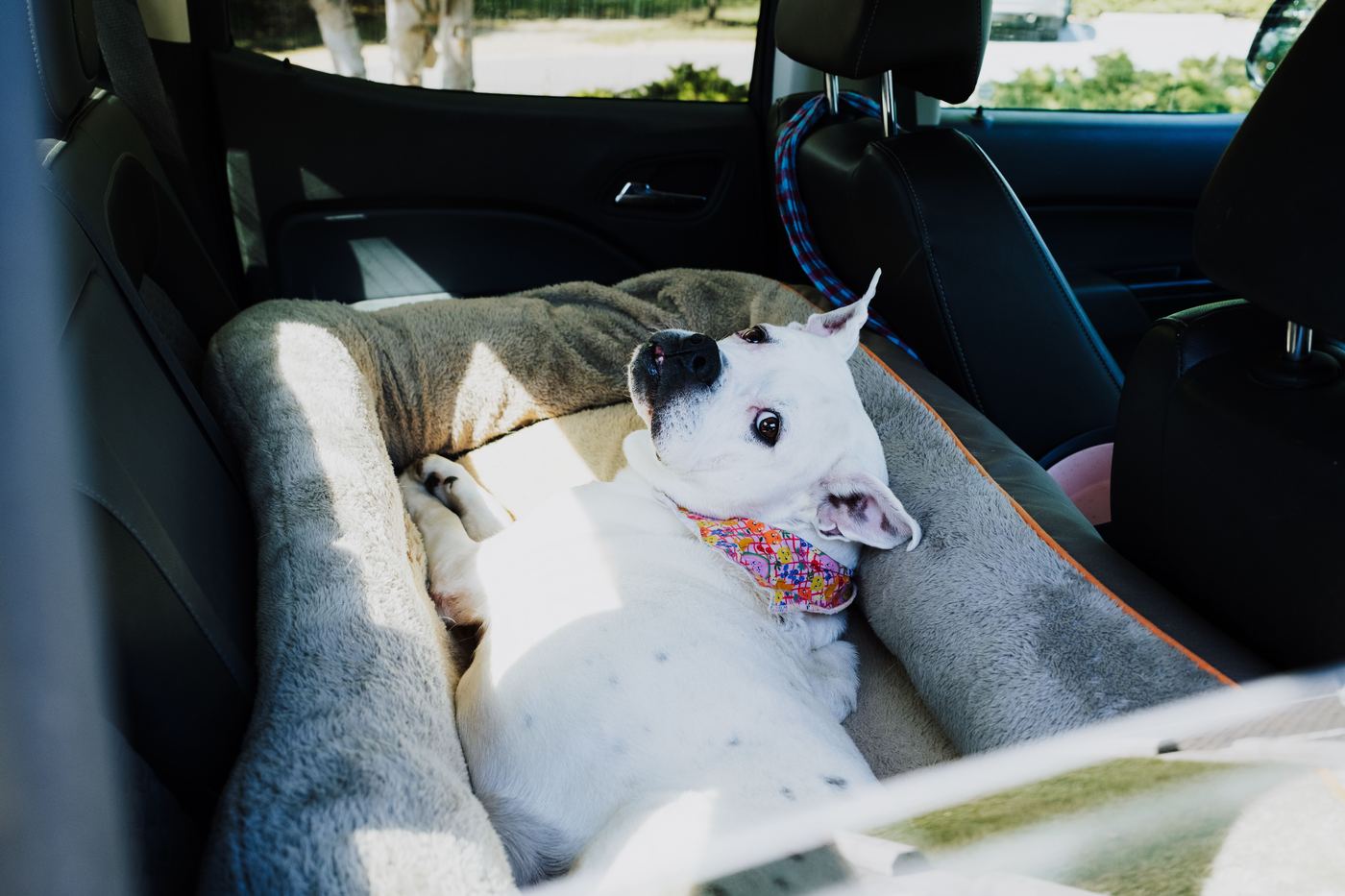
Seat covers complicate restraints in ways that surprise people. A cover with seatbelt slots lets the belt through, which is right, but a cover that slides on a leather bench rotates the whole setup in a corner, and a rotating anchor is a load path nobody designed. Fit the cover first, snug and anchored at every point the maker provides, then fit the harness and tether on top of the finished surface. Where a cover uses hard anchors between seat back and cushion, check that the tether line still runs flat along the bench and doesn't snag on the cover's edge at full stretch. And in wagons and SUVs where the tether anchors to cargo points, keep the line away from split-seat hinges, which pinch webbing quietly and completely.
Harness, crate or barrier: picking the restraint honestly
Harnesses and tethers suit calm-to-moderate travellers in the back seat. A crash-tested crate is the stronger option for small-to-medium dogs, and it has the bonus of containing the frantic moments after a minor bingle, when doors open and bolts happen. Barriers between cargo area and cabin protect the humans from the dog but do little for the dog, so I call them what they are: a people-protection device. Whatever you pick, the choice gets made in the driveway, not in the rear-view mirror.
| Check | Standard | Failure it prevents |
|---|---|---|
| Two fingers under every strap | Flat slide, no fight | Chafing, restricted breathing, escape by jaw |
| Chest strap position | On the breastbone, below throat | Neck loading in a stop |
| Tether anchor | Harness or belt anchorage, load-tested lean | Headrest tear-out, collar loading |
| Tether length | Sit, stand, turn; never the front seat | Projectile travel, window and door reach |
| Cover under restraint | Fitted and anchored first, no snag points | Rotating anchor, webbing pinch at hinges |
| Post-fit review | Re-check at every rest stop | Creep, loosening, chew damage going unnoticed |
The rest-stop habit that catches everything
Restraints loosen and covers creep, so every stop gets the thirty-second walkthrough: two fingers on the straps, tether line flat and unchewed, anchor still solid, cover still square. This habit has caught more problems in my own setup than any amount of pre-trip diligence, because dogs move in ways we don't see in the mirror. It costs half a minute and it is the difference between gear that is fitted and gear that is still fitted.
Frequently Asked Questions
Can I clip the tether to my dog's collar for a short trip?
No. Short trips are where the low-speed impacts live, and a collar-loaded stop is a throat-loaded stop. Fit the harness; it adds a minute to the trip and removes the single worst failure mode in cabin restraint. If the harness is such a hassle that you're tempted, that is the gear telling you to find one that goes on easier, not a reason to skip it.
My dog's harness was fine last month but rubs now. What changed?
Probably the dog, or the coat. Weight shifts, coat length changes with the seasons, and webbing stretches over a summer. Rubbing at the armpit or behind the shoulders means the geometry has drifted, so re-run the two-finger and strap-position checks from scratch. If a correctly fitted harness still rubs, the harness shape and the dog shape have disagreed from the start, and a different cut is the fix.
Are headrest anchor points strong enough for a big dog?
Some are engineered for load and some are just tubes, and you cannot tell by looking, which is why I teach the lean test: have the dog lean hard into the tether while you watch the headrest. Any lift, flex or creak fails the test. For large, strong dogs I would rather see a tether to the child-seat anchorage or a crash-tested crate, because the honest engineering answer is that a headrest was never designed to be a mooring point.
Does a seat cover interfere with a seatbelt-style harness?
Not if the cover has proper belt slots and the belt runs through them flat and untwisted. The problems start when the belt is pinched behind the cover's edge or when the cover bunches under the harness contact points. Fit the cover first, sit in the belt path with your hand and confirm it slides freely, then fit the dog. Two minutes of checking beats a twisted belt doing who-knows-what in a stop.
What about anxious dogs that fight the harness in the car?
That is a training project and a crate conversation happening at the same time. Start harness meals and driveway sessions weeks before the trip, because a dog that fights restraint in a moving car is a driver's-distraction risk on top of a projectile risk. Until the training lands, a secured crash-tested crate is the honest answer for the frantic traveller, because it contains the panic without anything tight around the body.
Looking for dog car seat covers?
We stock the gear covered in this guide, with Australia-wide shipping and Afterpay at checkout.
Shop Car Seat Covers at Paws of Oz