Solo Play and Shared Play: Toys for a Multi-Cat Home
Short answer: In a room shared by several cats, the toys that work are the ones that let cats take turns, and the ones that cause trouble are the single objects worth guarding. Put out one toy per cat, keep the wand for supervised sessions, and expect two or three cats in the group to prefer playing alone in a quieter corner.
The hardest part of a cattery day was never feeding. It was play, because play is where a shared room shows you its politics. Thirty cats in residence meant several rooms of four to six, and a wand toy in the middle of a room could go one of two ways. Sometimes the cats queued, each taking a turn at the lunge while the others watched from a shelf. Other times the biggest cat took the floor, two cats left, and the toy caught nothing but air for ten minutes. I started keeping two sets of toys, one for group rooms and one for the cats who did better alone, and the difference in noise was immediate.
Toys that create a queue not a standoff
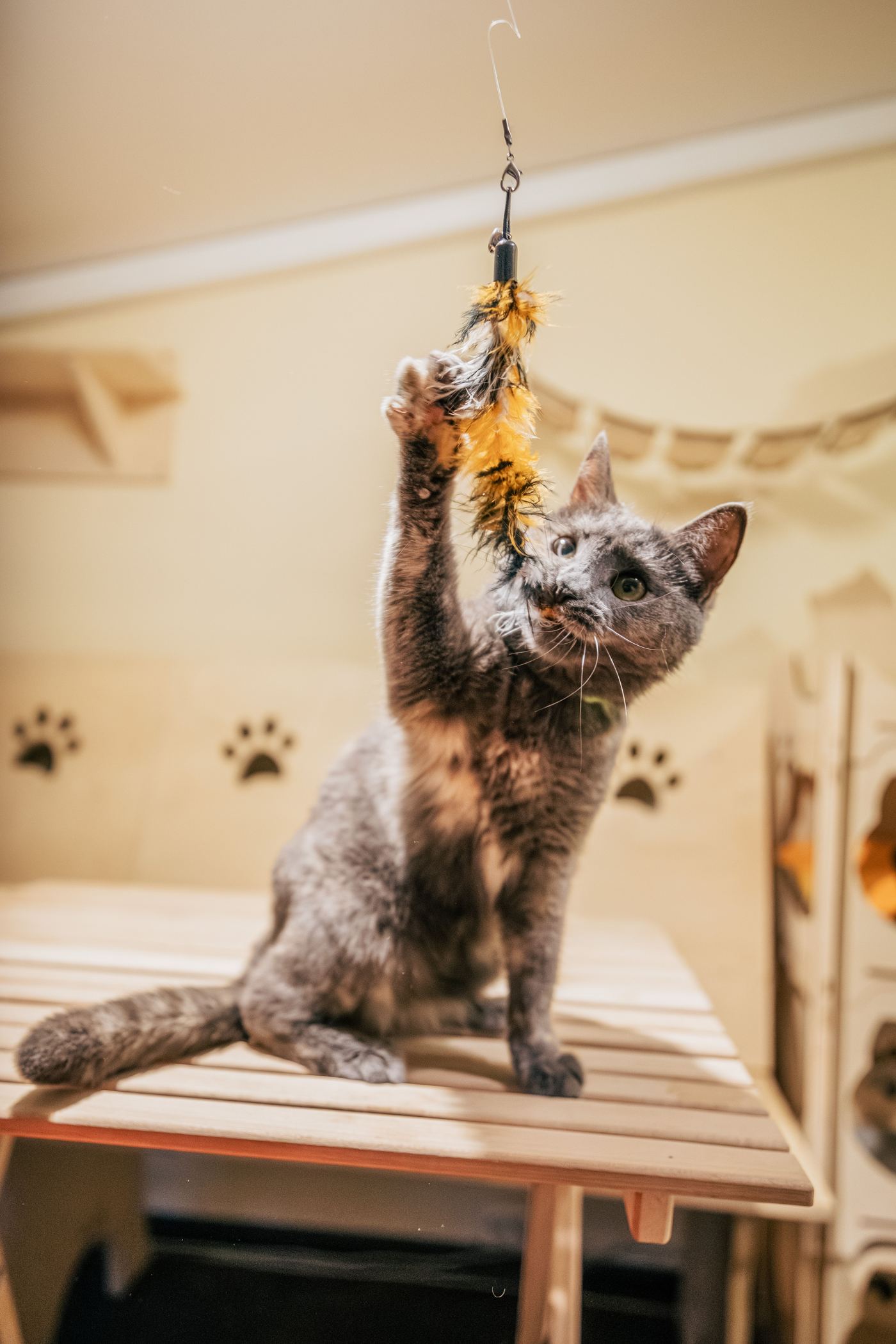
What makes a toy shareable is not the toy so much as the rhythm you run it at. A wand moved fast and low across the middle of a room rewards whoever is fastest and largest, and the rest of the room learns to sit out. A wand moved slowly, up onto a shelf, along a ledge and down behind a box, gives each cat a moment where the toy is in their space and the others are not close enough to take it. Wide, slow arcs and pauses are what produce a queue.
The same idea applies to tunnels and boxes, which work because they create separate positions rather than one contested point in the open. A laser does the opposite in company. It leaves nothing to catch, and the cats who never catch anything tend to get sharper with each other as the session goes on.
When a toy is really a resource
Watch for the toy that turns into property. In a boarding room that was usually a single plush kicker, one ball track, or a crinkle sack that one cat had decided was theirs. The signals were easy to read once I knew them. The cat would sit on or beside the toy, face the room rather than the toy, and watch the other cats instead of playing. Another cat approaching got a stare, a tail flick or a swipe.
Nothing about that toy was fun any more. It was a thing to defend, and defending it made the room tense for the rest of the day. The fix is not to strip the room bare. The fix is to notice the guarding early and put the contested object away, because a toy only one cat can use belongs in a solo session.
How many toys belong out at once
A room with six cats does not need thirty toys. It needs enough that every cat has something within reach, and few enough that the room does not become a course to patrol. As a working rule I kept one toy out per cat, plus one spare, in a room where the cats were settled with each other. That meant six or seven objects on the floor at any time, mostly balls, soft kickers and a tunnel, with the wand kept in a cupboard until someone was there to run it.
More than that and the room looks busy to us and cluttered to the cats, and the toys nobody touches just collect fur. Fewer than that and the confident cats work their way around taking everything. Rotate rather than pile up, and check that whatever comes off the floor is still sound. The toy guides here cover wash-and-return routines if you want the fuller version.
- Run a wand in slow wide arcs so every cat gets a turn.
- One toy per cat plus one spare is usually the right count.
- A cat sitting on a toy and staring is guarding, not playing.
- Keep the wand and the laser for supervised sessions only.
- Give shy cats a separate play session away from the group.
Solo toys for cats who will not compete
Some cats will not play in front of others, and they are not timid cats as a rule. Many of them were perfectly confident on their own and simply had no interest in a contest. For those cats the useful toys are the ones that work without a person and without an audience. A soft kicker they can wrestle on a shelf, a crinkle sack, a ball rolled into a shallow box, or a puzzle they can work at their own speed.
In the cattery these went into the pen with the cat and came out at the end of the day, which also stopped the toy becoming a guarded object. If a cat only ever plays alone, that is not a problem to fix. It is information about where to put the toy, and it tells you which sessions to keep separate.
| Toy type | Solo or shared | Suits which cat | What to watch for |
|---|---|---|---|
| Wand with feathers or ribbon | Shared, with a person | Confident cats who will take turns | Fast low movement lets one cat dominate |
| Soft plush kicker | Either | Cats who like to wrestle and kick | Often turns into a guarded object |
| Crinkle sack or tunnel | Either | Cats who prefer an ambush position | Fabric splits along the seams |
| Puzzle or roller ball | Solo | Cats who work things out slowly | Uneaten food left behind draws ants |
| Track or ball in a box | Solo | Cats who will not compete in the open | Easy for one cat to monopolise |

Reading the cat who has stopped playing
The cat you need to notice is not the one causing trouble. It is the one who stopped. In a shared room that shows up as a cat who stays on the highest shelf while the wand is out, or leaves the room the moment the tunnel comes down, or eats and then settles in a corner facing the wall. Most of the time those cats are still playing, just not when anyone is watching. I used to leave a soft kicker or a crinkle sack with them overnight and find it had been moved by morning.
Also worth watching is a cat who plays only when a particular other cat is out of the room. That tells you a great deal about the pair, and it is the sort of thing you notice by sitting still for half an hour rather than by reading a label.

Frequently Asked Questions
Do I need a separate toy for every cat?
Not separate toys so much as enough to go around. One toy per cat plus one spare is a workable starting point, and it matters less that each cat owns a particular object than that no cat has to wait or compete for the next turn. Rotate what is out every few days so nothing turns into property.
My two cats both want the same wand toy. What can I do?
Run it in slow wide arcs rather than fast low sweeps, so each cat gets a turn in their own space. Watch who is being pushed out and give that cat the next pass. If one cat still hogs the floor, split the session into two short turns with a pause in between, or take the quiet cat into another room for five minutes of their own.
Is a laser pointer a bad idea in a multi-cat home?
I stopped using one in shared rooms. The chase is fun for the fastest cat and frustrating for the others, and there is nothing to catch at the end, which leaves some cats wound up and sharper with each other afterwards. If you do use one, finish with a real toy the cat can catch, and keep it for a solo session.
How often should I change what toys are out?
Changing about a third of what sits on the floor every few days keeps the room interesting without making it busy. Wash anything that comes out of rotation before it goes back, and check each toy for split seams, loose bells and frayed string. Anything with a loose part should be mended, retired or binned rather than left out.
One cat hides whenever the toys come out. Should I be worried?
It is usually about the group rather than the toys. Some cats simply will not play in company, and they carry on playing when the room is quiet. Try leaving a kicker or a crinkle sack with that cat in a separate room and see whether it has moved by morning. If the hiding is new, or comes with changes in eating or toileting, ask your vet.
Looking for cat & dog toys?
We stock the gear covered in this guide, with Australia-wide shipping and Afterpay at checkout.
Shop Toys at Paws of Oz