Perth's Shared Path Rules and What They Mean for Lead Length
Short answer: On a busy shared path, keep your dog beside you on a lead of roughly 1.2 to 1.5 metres. Quiet suburban footpaths suit 1.8 to 2 metres, which still gives room to sniff the verge. Anything longer belongs in open space where you can see who is coming, because on a path with bikes you need to shorten fast.
I walk my two dogs on the same stretch of river path most mornings before my first grooming client, and what I notice is how differently people hold a lead once the path fills up. At 6.30 am a 2 metre lead looks generous. By 8 am, with commuter cyclists, a pram and three other dogs, that same lead is lying across the middle of the path and the owner is apologising to everyone. The lead did not change. The path did. Most of the length advice you read online assumes an empty park, and most of the walking people actually do in Perth happens somewhere much busier than that.
What a shared path asks of you
A shared path is signposted space for people walking, cycling, running and pushing prams, and in most Perth cases the dog is the only one of those on a lead. That single detail decides how the lead has to behave. On a footpath beside a road, your job is keeping the dog out of traffic. On a shared path, your job is keeping the dog out of the way of people moving faster than you, some of them approaching from behind at speed with very little warning. Management of these paths is set locally and the signage varies, so read what is posted at the entry rather than assuming the last path's rules carry over. What does not vary is the general expectation: dog on a lead, under control, not an obstacle.
Why path width caps your lead length
A shared path is usually somewhere between 2.5 and 3 metres of sealed surface carrying two-way traffic. If your dog is on a 3 metre lead and stops to sniff at the left edge, you have closed most of the usable width before anyone has to slow down. Add a cyclist coming the other way and a runner behind, and something has to give, which is normally the cyclist braking or swinging wide onto the grass. It is about how much of the path your dog can occupy the moment they stop, spin or step sideways. Think of lead length as the radius your dog can swing through, then look at how much width the path actually gives you.
Busy river stretches want a short lead
The river paths are the busiest walking I do, and that is where I use the shortest lead. Morning and evening there are cyclists commuting, rowers walking back to the car park, families with small children, and a lot of dogs, not all of them friendly. On that surface I want the dog close enough that my hand can feel what they are about to do before they do it. A 1.2 metre lead puts a Labrador's nose roughly at my knee, which means I can step into the gap when someone passes instead of hauling the dog backwards. On a narrow busy stretch, short is not restrictive. It is the only length that lets you both move politely.
Suburban footpaths suit the middle lengths
Suburban footpaths are a different job. There is less traffic in both directions, more grass verge, and more stopping, which is where a slightly longer lead earns its place. Around 1.8 to 2 metres lets a dog drift onto the verge to sniff without stepping into the roadway, and it gives a little slack when you stop to talk to a neighbour. The risk on a footpath is the driveway and the crossing, not the crowd. You want enough lead for sniffing and enough spare in your hand to gather it fast when a car reverses out of a driveway. If you walk the same footpath every day, this is the length that covers most of it.
- Busy shared path: about 1.2 metres, dog beside your knee.
- Quiet suburban footpath: 1.8 to 2 metres, enough slack to sniff the verge.
- Long lines belong in open space, not on mixed-use paths.
- Treat lead length as the radius your dog can swing through.
- Read the signage on each path, because management and expectations vary.
Walking the route you actually walk
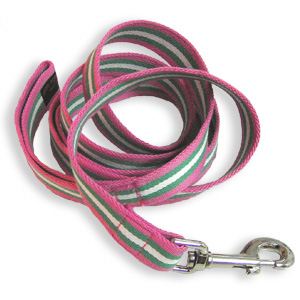
Most people own one lead and walk half a dozen places with it, so the length has to be a compromise. I tell clients to set it for the walk they do most often, not the one they do on a Saturday. If your weekday walk is a busy river path, buy short and accept that the park will feel tight. The alternative is a lead that adjusts, either a training lead with two or three rings or a fixed lead with a second handle lower down. Both let you gather the dog in at a crossing and give slack again on the verge without carrying two leads. If you are working out what your walk needs, the lengths grouped under dog leads make the comparison easier than guessing from a photo.
| Lead length | Where it works | What to watch |
|---|---|---|
| 1.2 metres | Busy river paths and crowded shared stretches | Very little room to sniff, and you will want more elsewhere |
| 1.5 metres | Everyday mixed paths with bikes and prams | Still enough swing to reach the middle of the path if the dog stops |
| 1.8 to 2 metres | Suburban footpaths and quiet verges | On narrow footpaths it reaches the kerb and the driveways |
| 3 metres | Open park grass with clear sightlines | Blocks most of a shared path the moment a bike appears |
| 5 metres and over | Recall practice in fenced or open space | Needs two hands and constant management, so not a path lead |
Reading the signs and the traffic ahead
Two habits make any lead length work. The first is looking further ahead than feels necessary. A cyclist closing quickly covers a lot of ground while you are watching your dog sniff, so lift your eyes about 30 metres up the path every few seconds and you will have time to gather the lead before it matters. The second is holding the lead in the hand away from the centre of the path, with the slack gathered in loops rather than wrapped around your wrist. Requirements for shared paths differ between local areas, so check the signs where you enter rather than assuming the last path's rules apply here. A long line is technically still a lead, but on a busy path it is not a polite one.
Frequently Asked Questions
Can I use a retractable lead on a shared path?
You can, but the length is the problem rather than the mechanism. A retractable lets the dog move out to 5 metres or more, which is far more path than a busy stretch can absorb. If you use one, keep it locked short whenever anyone else is in sight and let it out only when the path is genuinely empty. Check the local signage as well, because requirements vary.
How short is too short for a walking lead?
Too short is when the dog cannot walk at a normal pace or has to lean away to keep slack out of the line. Beyond that, shorter is fine. A 1.2 metre lead on a Labrador still leaves room to walk comfortably beside you. Watch your dog's gait rather than the number on the packet, and step up a size if they are constantly stopping.
Do I need a different lead for the beach?
Beaches are open space, so a longer line is reasonable there, but dogs on Perth beaches are still expected to be under control and many stretches are on-lead only. A 3 metre lead or a long line works on open sand, and it should be rinsed in fresh water afterwards because salt and sand chew through stitching and clips. When the beach gets busy, shorten it back down.
What is the best setup for walking two dogs on shared paths?
Two leads, one in each hand, both short. A coupler looks tidy but it turns two dogs into one wide obstacle and they can wrap each other when a bike passes. Separate leads let you gather one dog while the other keeps walking. Practise the arrangement on a quiet footpath before you take it onto the river, because two lines and a passing cyclist takes some habit.
How do I know a lead is long enough for sniffing walks?
If the dog can step onto the verge and put their head down without pulling the line tight, it is long enough for that walk. If you are leaning forward to give slack, or the dog keeps stopping because they have run out of lead, it is too short for sniffing. Most people end up with two lengths: one short lead for paths and one longer option for parks.
Looking for dog leads & walking gear?
We stock the gear covered in this guide, with Australia-wide shipping and Afterpay at checkout.
Popular in this range: mesh harness & lead set · hands-free running leash
Shop Leads & Walking at Paws of Oz