Indoor Cat Playpen: A Safe Roaming Space for Your Cat
Short answer: an indoor pen is the right call for a frightened rescue cat because it gives her a small, safe world on day one instead of a whole flat to vanish into. Miso hid behind the washing machine for nine hours before a foldable pen next to the window settled her, and ours twists to a flat disc about six centimetres thick. If you only read one part, make it the setup checklist, since the under-three-kilo disc slides away before a rental inspection.
The night I brought Miso home from the shelter, she vanished. Not out a window — behind the washing machine, into a gap I did not know existed, and she stayed there for nine hours while I lay on the laundry floor talking softly to a set of pipes. I am telling you this because it is the exact problem an indoor cat playpen solves, and nobody at the adoption centre thought to mention it. A whole flat, even a small one, is far too much house for a frightened cat on day one.
Two days later I had a foldable pen set up in the lounge room, and Miso went from a shape in a shadow to a kitten who ate in front of me. This is how I set it up, what I would change, and what I have honestly learned about keeping a cat safely contained in a rental.
Why a smaller world helps a nervous cat
My instinct was that Miso needed freedom. She needed the opposite. Cats work out a territory by mapping it — every corner, every escape route, every place a threat could come from — and until that map is finished they stay switched on. Hand a scared kitten 60 square metres and she has to survey all of it before she can relax, which takes days and costs her a lot of sleep and appetite.
Give her one defined square metre with her food, water, litter tray and bed in it, and the mapping job takes twenty minutes. Once it is done, she can eat, groom and sleep, and everything after that happens from a position of calm rather than dread. Shelter and foster carers do this with a spare bathroom. I do not have a spare bathroom. I have a mesh-topped pen in the corner of the lounge, and functionally it does the same job while letting her watch the household through the sides.
The watching part matters. A closed door means safety with no information. An indoor cat playpen means safety plus a view of the kettle, the vacuum, the front door and, eventually, the puppy. She got to update her risk assessment of the whole flat from somewhere she felt secure, which is a much faster path to confidence than being shut in a room.
My cat playpen setup checklist
I fiddled with the layout for a fortnight before it clicked. Here is the version that actually worked, with roughly what each piece cost me.
| Item | Where it goes | Why it matters | Approx. AUD |
|---|---|---|---|
| Foldable pen, 85–90 × 85–90 × 58–60cm (M) | Quiet corner, against one wall, near a window | Two solid sides feel safer than four open ones; the window gives her something to do | $69 – $85 |
| Zip-on mesh top | Closed whenever I leave the room | A 58–60cm wall alone will not hold a determined cat; the top is what makes it an enclosure | Usually included |
| Covered bed or igloo | Corner furthest from the door | Cats hide to feel safe. Without a hidey-hole they press into a seam and stay tense | $25 – $40 |
| Small litter tray, low sides | Diagonally opposite the food, as far as the pen allows | Cats will not toilet next to their dinner. This is the most common setup mistake | $12 – $20 |
| Shallow water bowl, ceramic | Away from the tray, off to one side | Ceramic does not tip or hold plastic smells; shallow suits whiskers better | $10 – $18 |
| Cardboard scratcher, flat | Along one wall of the pen | Gives her somewhere legitimate to scratch, which protects the mesh and my carpet | $15 – $25 |
| Washable rug or old towel | Under the whole pen | Grip on floorboards, and it catches anything the water-resistant base would eventually leak | $15 – $30 |
| Upturned crate or stool | Inside, one corner | Vertical space. A cat who can get higher than everything else calms down dramatically | Free, or $10 |
| Worn t-shirt of mine | In the bed | My scent stops being a stranger's scent. Cheapest and most effective item on the list | Free |
Total, excluding the pen, came to under a hundred dollars, and half of it I already owned. The two changes that made the biggest difference were the covered bed and the upturned crate. Before those, Miso sat flat against the fabric with her ears back. After, she slept on top of the crate with her paws tucked, which is the posture of a cat who has decided she is fine.
- Foldable pen in a quiet corner against a wall, near a window.
- Covered bed or igloo in the corner furthest from the door.
- Small litter tray diagonal from the food, with low sides.
- Cardboard scratcher along one wall to protect the mesh.
- Worn t-shirt in the bed so your scent stops being strange.
Introducing a cat to the pen without ruining it
I nearly got this wrong. My first move was to pick her up and put her in, which taught her that the pen is a place hands deposit you against your will. It took three days to undo.
What worked was leaving it open and boring. I set the pen up with the door unzipped and simply fed her in there, three times a day, without hovering. No shutting anything. After about four days she was going in on her own to nap because that is where the good bed and the sun patch were. Only then did I start zipping the door for ten minutes at a time while I stayed in the room, then twenty, then an hour.
The rule I now follow: the pen has to be somewhere she chooses to be before it is ever somewhere she has to be. If you skip that, you end up with a cat who yowls the moment the zip moves, and you will not fix it by waiting her out.
One thing I watch for is any change in eating, drinking or toileting during confinement. A cat who stops using the tray, refuses food for more than a day, or strains and produces nothing is not being stubborn — that is a call to the vet, not a training problem. Miso once went off her food for a day after her vaccinations and I was straight on the phone. It was nothing, and I would do the same again.
What a foldable pen does and does not contain
I want to be straight about this because the product photos are optimistic. A soft-sided cat pen foldable enough to twist into a flat disc is not a cage, and it should not be sold to you as one.
Walls of 45cm will not hold any healthy cat past about four months. Miso cleared that height at five months from a standing start, without appearing to try. Walls of 58–60cm with the mesh top zipped shut are a genuine enclosure and she has never got out of ours. Walls of 58–60cm with the top open are a suggestion she will accept only while she is happy in there.
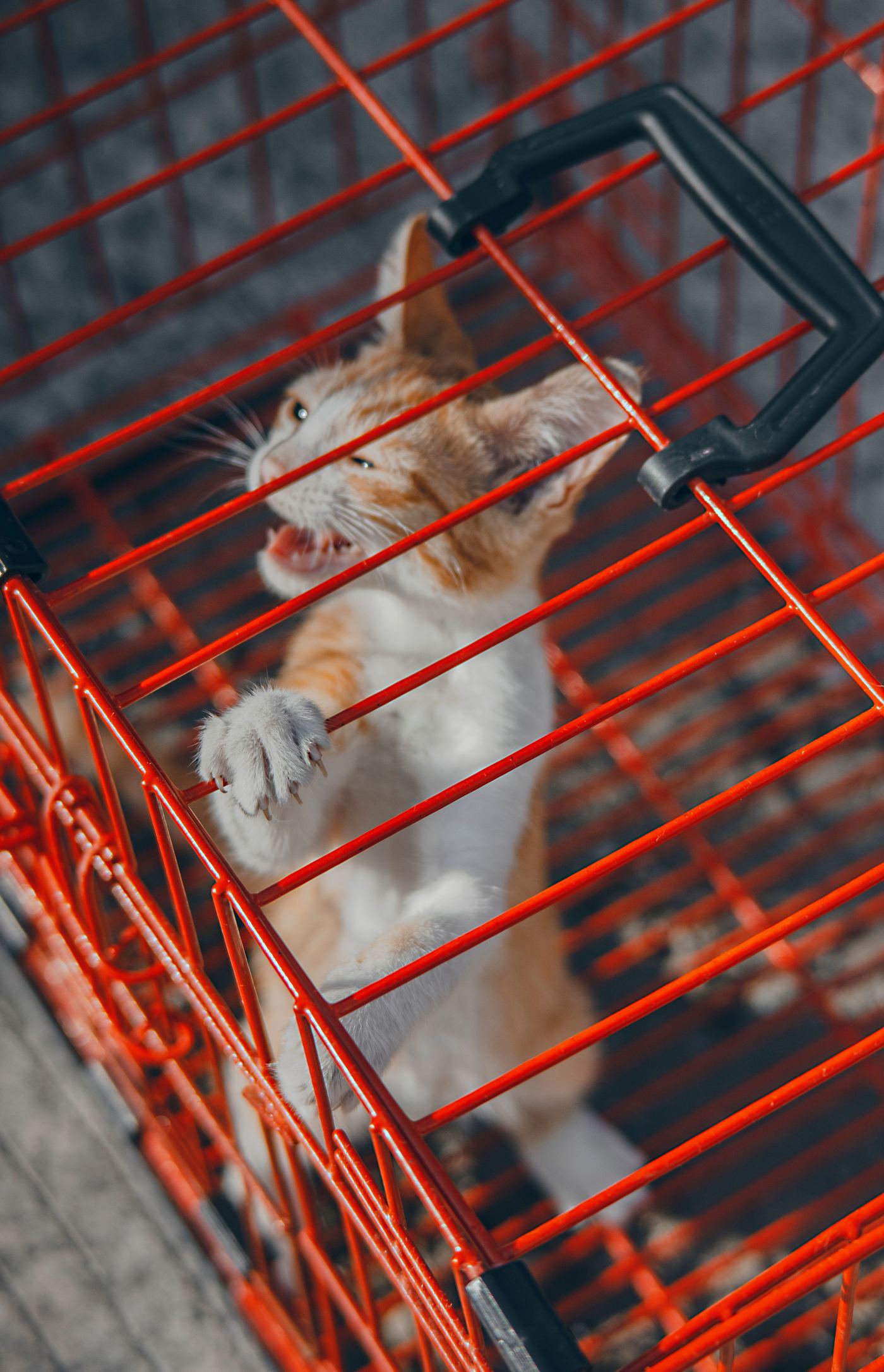
Claws are the wear point, not the walls. There is a patch of pulled threads on our mesh top from the fortnight Miso decided it was a hammock. It has not spread, it is purely cosmetic, and it happened because I had not yet given her a legitimate scratcher inside. Once the flat cardboard scratcher went in, the mesh stopped being interesting.
It also will not stop a cat who is genuinely panicking. Nothing soft will. If your cat throws herself at the sides, the answer is to reduce whatever is frightening her and go back a few steps, not to add a heavier pen. A cat who fights the enclosure hard enough can injure a claw or a tooth, and that risk is not worth winning the argument.
Why this suits renters especially
My lease says no fixings, no adhesive hooks, no modifications, and I would like my bond back in full. That rules out most permanent cat-proofing.
A pen needs nothing but floor. Nothing screws into a skirting board, nothing clamps to a doorframe, no tension rod dents plaster. When the property manager came for the six-month inspection I folded it down and slid it behind the couch, and the flat looked like a flat rather than an animal facility. That took twenty seconds.
It is also portable in a way a spare room is not. When I painted the bedroom I moved Miso's whole world into the kitchen for a day, still assembled, using two hands. When I housesat for a friend over Easter, the pen came with me and Miso had her familiar bed, her familiar smell and her familiar boundaries in a strange house. She settled in an hour instead of three days.
The last one, which I did not anticipate: it made introducing Wally survivable. For the first fortnight Miso could sit inside the mesh and stare at a bouncing Cavoodle puppy from a place he could not reach. She learned he was noisy and harmless without ever being cornered by him. I genuinely think that fortnight is why they now sleep on the same rug.
Where mine lives now
Miso is fourteen months old and has the run of the flat. The pen is still up, in the same corner, door open, because that is where she sleeps between about ten in the morning and three in the afternoon. I stopped thinking of it as containment somewhere around month four and started thinking of it as her bedroom.
It comes into service for vet days, for the four hours after her dental when she was groggy, for tradie visits when the front door is propped open, and for the two weeks a friend's cat stayed with us. Being able to conjure a safe, familiar, cat-sized room out of a flat disc behind the couch has been worth every dollar of the eighty I spent.
If you have a nervous cat, a small rental, or a new arrival still deciding whether your house is safe, this is where I would start. Not because it restricts them, but because a smaller world is easier to trust.
Frequently Asked Questions
Frequently asked questions
Is it cruel to keep a cat in a playpen?
Not for short, purposeful stretches with everything she needs inside — food, water, a litter tray, a bed and something to scratch. It becomes a problem if it is used as long-term storage rather than a settling-in or recovery space. Mine is used for a few hours at a time at most, and the door is open the rest of the day. If your cat consistently fights it, stop and reassess rather than pushing on.
How high do the walls need to be to hold a cat?
Higher than you think, and honestly the top matters more than the height. A 45cm wall is nothing to an adult cat. A 58–60cm wall with the zip-on mesh top closed has held Miso reliably since she was a kitten. With the top open, treat any soft pen as a boundary your cat is choosing to respect rather than a barrier.
Where should the litter tray go inside the pen?
As far from the food and water as the pen allows, which usually means diagonally opposite. Cats will hold on rather than toilet next to their dinner, and a tray placed badly is behind most of the accidents people blame on the pen itself. In a medium pen that diagonal is only about a metre, so use every centimetre of it.
Can my cat and my puppy use the same pen?
In shifts, yes, and that is how we started — Miso in the mornings, Wally in the afternoons. Together, only with supervision and only if the cat has something to climb on inside, because a cat who can get above a dog stays relaxed and a cat stuck at floor level does not. I never leave the two of them in there unattended.
How do I stop my cat scratching the mesh?
Put a legitimate scratching surface inside from day one. A flat cardboard scratcher along one wall solved it for us in about two days. The pulled threads on our mesh top all date from the fortnight before I worked that out. Keeping claws trimmed helps too, and a bit of cosmetic damage is normal wear rather than a fault.
Does it fold down small enough for a small flat?
Ours twists into a flat disc roughly 6cm thick and weighs a bit under 3kg, so it slides behind the couch, under the bed or flat into the boot of a small car. Being able to make it disappear before a rental inspection is one of the main reasons I bought this style rather than wire panels.
Looking for pet playpens?
We stock the gear covered in this guide, with Australia-wide shipping and Afterpay at checkout.
Popular in this range: outdoor catio with tunnel · large pop-up cat tent
Shop Playpens at Paws of Oz