Memory Foam, Egg Crate or Fibre Fill? What's Actually Inside a Supportive Bed
Short answer: density beats thickness, so pay for high-density or memory foam over a thick-looking fibre fill that flattens under a dog within months. Rehab work in Hobart showed me the fill, not the cover, is what decides whether a supportive model actually supports the animal on it. You'll want the memory foam one beside your own if your dog is older or sore, because Pip walks past her lounge bed, now the thickness of a folded towel, and chooses the version that still springs back when she stands.
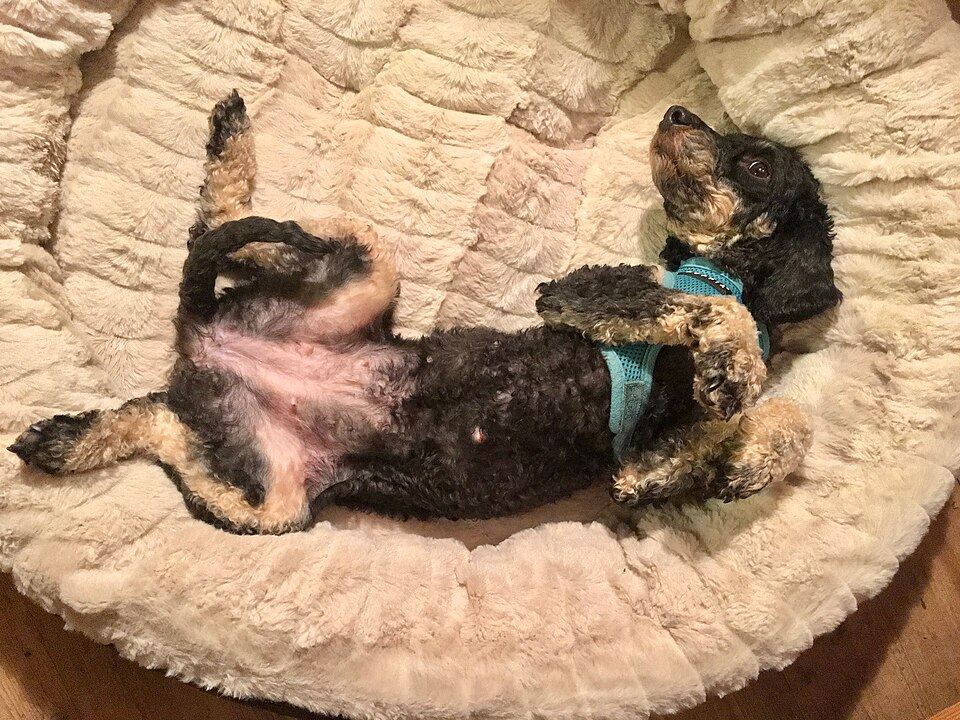
Pip has two beds. The one in the lounge is about eighteen months old, was cheap, and is now roughly the thickness of a folded towel — when she lies on it I can press a hand down beside her hip and feel the tiles through the base. The one next to my bed cost three times as much and still springs back when she stands up. Same dog, same house, and these days she walks past the lounge bed most evenings. That difference isn't the cover or the shape. It's what's inside.
I work as a veterinary nurse and assist with animal rehabilitation in Hobart, and after "what size", the question I field most often is which fill to buy. The answer depends on the animal, the climate and your budget, and it starts with knowing what the three common fills actually do.
Three fills, and what they really are
Nearly every pet bed sold here is one of three things inside: loose polyester fibre, a sheet of convoluted foam shaped like an egg carton, or a slab of denser foam, either high-density polyurethane or viscoelastic memory foam. Plenty of beds stack them — a foam base under a fibre topper, or an egg crate layer over a solid slab. The labels are where it gets muddy, and the word "orthopaedic" isn't regulated in this category. Anyone can print it.
Fibre fill: cheap, soft, washable, temporary
Polyester fibre, usually sold as PP cotton under a dozen trade names, is what's in most budget beds. It's genuinely soft, it's light, it dries fast, and the whole bed generally goes in the washing machine, which matters enormously for a puppy or a cat with a dicky stomach. For a small dog I'd pick it without hesitation.
The problem is physics. Fibre works by trapping air in a loft, and loft collapses under sustained weight. A five kilogram cat flattens a fibre bed slowly over a year or so. A forty kilogram greyhound compresses it to a few centimetres in an afternoon, and after a few months the fill migrates outward and stays there. Once Pip's lounge bed reached that point she was effectively lying on the floor with a blanket over her.
You can revive a flattened fibre bed by pulling the fill apart and tumbling it on low with a couple of tennis balls, but with a big dog expect to do that every few washes and to replace the bed annually.
Egg crate foam: a genuine step up
Egg crate is a foam sheet with a peaked, convoluted surface, which is where the name comes from. The peaks spread load across a wider area than flat foam of the same weight, and the channels between them let a little air move, so the surface doesn't get as hot as solid foam. It's usually sold as a two to five centimetre sheet under a removable washable cover, and that cover is the best feature in this bracket. You strip it, wash it, and the foam stays dry.
Honestly, it sits one clear step above fibre and one clear step below a proper dense slab. It suits medium dogs, senior cats who've started choosing the floor, and anyone who wants something washable without paying memory foam prices. It compresses eventually, as all foam does, but far more slowly than fibre, and evenly rather than sliding into one corner.
Memory foam and high-density foam
This is the expensive end and, for a heavy or stiff dog, usually the right end. Memory foam softens with body heat and moulds to the animal lying on it, spreading weight over the largest possible area. High-density polyurethane resists compression rather than moulding, and for a very heavy dog I often think it's the better of the two, because soft memory foam can let them sink until they're resting on the base anyway.
Two honest drawbacks. Cost, which is real and sometimes wasted on a young dog who'll chew it. And heat, which in Australia is not a small point at all.
Heat: the part the packaging skips
Memory foam holds warmth by design; that's how it responds to body heat. In a Hobart winter that's a feature. In a Perth or Brisbane summer, a thick memory foam bed can be genuinely unpleasant to lie on, and I've watched dogs abandon an expensive bed for the bathroom tiles in January. If you live somewhere hot, look at dense foam with a breathable cover, an elevated cot-style bed, or a fibre bed you swap in for summer.
Pip runs warm for a greyhound, so she has a fibre bed for summer and a dense foam one for winter. Two beds sounds extravagant until you've watched a dog pant, circle and give up on a bed she slept in happily in July.

Density beats thickness
If you take one thing from this, make it this. A fifteen centimetre bed of soft fibre is worse for a heavy or older dog than a seven centimetre slab of dense foam. What helps reduce pressure on bony points — hips, elbows, shoulders, the hocks on a greyhound — is resistance to compression, not depth. Marketing leans on thickness because it photographs well and prints as a big number on the box.
The test I use: press your elbow into the middle of the bed as hard as you can. If you can feel the floor, so can your dog's hip.
What a supportive bed does and doesn't do
I'll be blunt here, because this category overreaches and because people searching for a dog bed for hip dysplasia in particular deserve straight talk. A bed doesn't treat hip dysplasia. It doesn't treat or prevent arthritis, and it doesn't change the course of joint disease. What a supportive surface does is help distribute weight and reduce pressure on the points that hurt when an animal lies on a hard floor, which can make settling easier and can mean less stiffness in the morning. That's a comfort outcome, and it sits alongside proper veterinary care rather than instead of it.
If your dog is struggling to rise, limping, slowing on walks or reluctant on stairs, that's a vet appointment, not a purchase. Same for a cat who's stopped jumping onto the bench. Pain relief, body condition, appropriate exercise and sometimes surgery are the levers there.
Matching the fill to the animal
Kittens, cats and small dogs under about ten kilos suit fibre or egg crate, with washability the priority — cats in particular like a surface they can knead into shape. Medium dogs between ten and twenty-five kilos are usually best served by egg crate foam under a removable cover. Large dogs over thirty kilos, and seniors of any size who are stiff in the mornings, do better on a dense foam base of at least seven to ten centimetres, with a cover that unzips. In hot climates, think about airflow before price.
I still buy fibre beds for the cats and for summer, because they wash beautifully and nobody minds when they get flattened into a pancake. For Pip at twelve, on tiles, in a Hobart winter, the dense slab was worth every dollar. Kneel on a bed before you buy it — and if your dog is genuinely sore, ring the vet first and shop second. — Tessa, Hobart, beside a greyhound on the expensive bed.
- Kittens, cats and small dogs under ten kilos suit fibre or egg crate.
- Medium dogs between ten and twenty-five kilos suit egg crate foam.
- Large dogs over thirty kilos do better on a dense foam base.
- Seniors who are stiff in the mornings need dense foam with a cover.
- In hot climates, think about airflow before you think about price.
Frequently Asked Questions
Is memory foam worth the extra cost for a dog bed in Australia?
For a large, heavy or older dog, usually yes. For a young healthy dog or any cat, not necessarily. The real catch in Australian climates is heat — memory foam retains warmth, which is lovely in a Hobart winter and miserable in a Perth summer. In hot regions, a dense foam with a breathable cover or an elevated bed is often the better buy.
What is egg crate foam and is it supportive?
It's a foam sheet with a convoluted, peaked surface. The peaks spread weight over a wider area and the channels between them allow some airflow, so it stays cooler than solid foam. It's a clear step up from polyester fibre and a step below a dense memory or high-density foam slab. Look for one with a removable, washable cover.
Does an orthopaedic bed help a dog with hip dysplasia?
A supportive bed can help reduce pressure on bony points and make resting more comfortable, which may mean less morning stiffness. It does not treat hip dysplasia, arthritis or any joint disease. Dogs with hip dysplasia need proper veterinary assessment and a management plan; think of the bed as an addition to that plan, not a substitute.
How thick should a dog bed be?
Density matters more than thickness. Seven to ten centimetres of dense foam will outperform fifteen centimetres of soft fibre for a heavy dog, because what matters is resistance to compression. Press your elbow firmly into the centre of the bed — if you can feel the floor through it, the fill is too soft for your dog's weight.
Which fill is best for senior cats?
Most senior cats do well on a supportive but softer surface they can still nest into, such as egg crate foam with a washable cover, or a fibre bed with a low raised edge they can rest their head on. Prioritise easy washing and a low entry height, since jumping and stepping over high sides gets harder with age.
Size & Fit Reference
| Size | External (L×W×H) | Internal sleeping area | Suits pets up to | Typical pets |
|---|---|---|---|---|
| S | 43 × 32 × 10 cm | ~36 × 25 cm | 30 cm curled | Kittens, toy breeds, small cats |
| M | 54 × 42 × 11 cm | ~46 × 34 cm | 45 cm curled | Cavoodle, Pug, average cat |
| L | 66 × 50 × 12 cm | ~57 × 41 cm | 55 cm curled | Cocker Spaniel, large cat |
| XL | 80 × 60 × 13 cm | ~70 × 50 cm | 70 cm curled | Kelpie, Border Collie |
| XXL | 95 × 72 × 15 cm | ~84 × 61 cm | 85 cm stretched | Labrador, two small dogs |
| 3XL | 110 × 82 × 15 cm | ~98 × 70 cm | 100 cm stretched | Great Dane, two medium dogs |
Between two sizes, size up. Note that soft polyester fill compresses under weight — for dogs over about 30 kg, a denser foam base will hold its loft far longer than fibre fill.
Looking for beds & mats?
We stock the gear covered in this guide, with Australia-wide shipping and Afterpay at checkout.
Popular in this range: self-cooling pet mat
Shop Beds & Mats at Paws of Oz