Teaching a Settle Cue Before Storm Season: A Trainer's Plan
Short answer: the best time to prepare a noise-sensitive dog for storm season is before it starts, and the most useful skill you can teach is a reliable settle cue. I'm Daniel, a certified trainer, and the plan below builds that cue in about three weeks with short daily sessions. A dog who settles on a mat when asked is far easier to support through thunder than one with no practice at all. Pair it with a safe space and you've got a plan rather than a hope. You can read more of our approach in the calming hub if you want the wider picture.
What a settle cue actually gives you
A settle cue is a word your dog learns to mean relax here, it's fine. It isn't a down stay, it's a softer, choosy calm. On a storm night that cue becomes the thing you reach for instead of panicking yourself, and your dog gets a job to do when everything else feels strange.
I teach it on a mat so the mat itself becomes part of the signal. Over time the dog sees the mat and switches into rest mode, which is exactly what you want when the sky gets loud. It also travels, since the mat can go in the car, to a friend's place or into a laundry during a storm, so the cue isn't tied to one room.
Setting up the mat and the marker
Pick a non-slip mat you can move around, ideally with a texture that's clearly different from the floor. Choose a marker too, either a clicker or a short word like yes, and use it consistently. The marker tells the dog exactly which moment earned the reward, which is what makes this work.
Keep a treat pouch on you rather than on the bench. Rewards need to land within a second or two of the behaviour, and walking to the kitchen each time means you'll be marking the wrong moment half the time. Set yourself up before you start, because fumbling for treats is the most common reason a session goes flat.
Week one: capturing calm on the mat
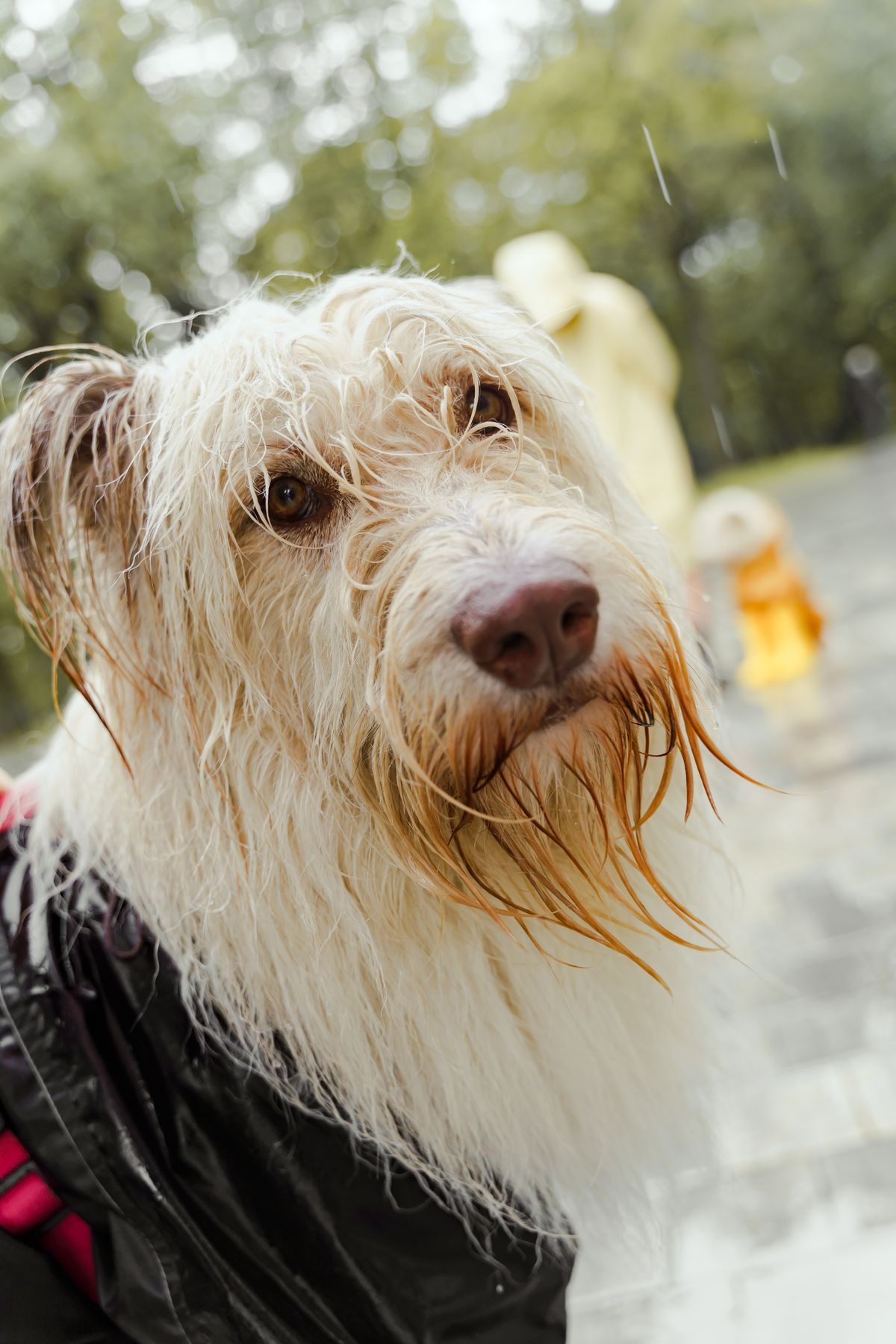
Throw the mat on the floor and wait. The moment your dog lies down near it, mark and reward. Don't ask for anything, just catch the calm. Five minutes a day is plenty for most dogs, and two short sessions beat one long one, because a tired dog learns nothing useful about relaxing.
By the end of the week your dog should be offering a down on the mat for the promise of a reward. If they're pacing or staring at the treat hand, you've moved too fast, so drop back to simply marking any glance at the mat. The goal is a dog who thinks the mat is the comfiest place in the house, not a dog who's working for a biscuit.
Week two: adding the word
Once the down is reliable, say your settle word just before they lie down, so the word predicts the behaviour. Mark and reward as before. Over a few days the word alone should start the settling, and you can begin to reward the stay rather than the drop, stretching the calm from seconds to a minute or two.
Keep the rewards real but small, and fade them to every second or third calm moment so the behaviour doesn't depend on a constant stream of food. A dog who only settles for a treat isn't settled, he's negotiating, and that falls apart the night the thunder drowns out the rustle of the pouch.

Week three: proofing around noise
Now add gentle distractions, starting with the TV at normal volume, then a vacuum in the next room, then a soft thunder recording at a level they ignore. The cue should hold through small chaos, which is the whole point. If they break, the noise is too high, so back off a notch and rebuild.
This is also where you link the cue to the safe space. Send them to the mat in the laundry with the radio on, say settle, and let them learn that the noisy world outside is none of their business. By storm season the word alone can talk them down from the first rumble, which is a genuinely useful thing to have in your pocket.
Common mistakes that stall progress
The big one is asking for too much too soon, usually because the owner is keen and the dog looks ready. Keenness skips the boring middle weeks where the calm actually gets solid. The second is inconsistent marking, where sometimes the down earns a reward and sometimes it doesn't, so the dog never learns the rule.
- Use one word and one marker, every single time.
- Keep sessions under ten minutes, twice a day.
- Reward calm, not just the down position.
- Raise distractions only when the last step is easy.
- Practise in the real safe space before storm season.
| Week | Goal | Daily time | Advance when |
|---|---|---|---|
| Week 1 | Capture calm on mat | 5 min, twice | Dog offers a down willingly |
| Week 2 | Add the word | 5 min, twice | Word starts the settle |
| Week 3 | Proof with noise | 10 min, daily | Cue holds through TV level |
| Storm prep | Use in safe space | As needed | Settles with radio on |
| Maintenance | Weekly refresh | 2 min | Still responds first try |

Frequently Asked Questions
How long does it take to teach a settle cue?
For most pet dogs, roughly three weeks of short daily sessions gets a reliable cue, though a puppy or a very excitable dog may need longer. The timeline depends far more on consistency than on talent, so two five-minute sessions a day beat a weekly marathon. You're building a habit, not performing a trick, so the calm needs to be real before you trust it on a storm night.
Can I teach this to an older dog?
Absolutely, and older dogs often learn it faster because they've got more patience than a bouncy youngster. The method is the same: capture the calm, add the word, then proof around noise, just at the pace that dog needs. An older noise-sensitive dog gains as much from a settle cue as a puppy does, sometimes more, because it gives them a known job when the sky gets loud.
What word should I use for the cue?
Pick a short word you don't already use for something else, like settle, relax, or mat, and stick to it forever so the dog never gets conflicting information. Avoid a word that sounds like sit or stay, because similar sounds blur together for a dog. Say it once, calmly, and let the training give it meaning rather than repeating it like a nag.
Will a settle cue stop thunder fear completely?
It won't erase a deep noise phobia on its own, but it gives the dog a practised calm to fall back on and gives you a clear plan instead of panic. Paired with a safe space and sometimes a collar, it handles a lot of mild to moderate cases well. For severe fear, treat the cue as one tool in a bigger plan that may include your vet, not as the whole answer.
My dog won't lie on the mat, what do I do?
Make the mat more valuable before you ask anything of it, by scattering a few treats on it at mealtimes and letting him discover it's the comfiest spot going. Don't lure him down with a treat over his head, because that teaches a different behaviour. Just mark the moment he chooses to lie there himself, and keep sessions short so the mat stays associated with good things, not pressure.
Looking for calming & anxiety?
We stock the gear covered in this guide, with Australia-wide shipping and Afterpay at checkout.
Shop Calming at Paws of Oz